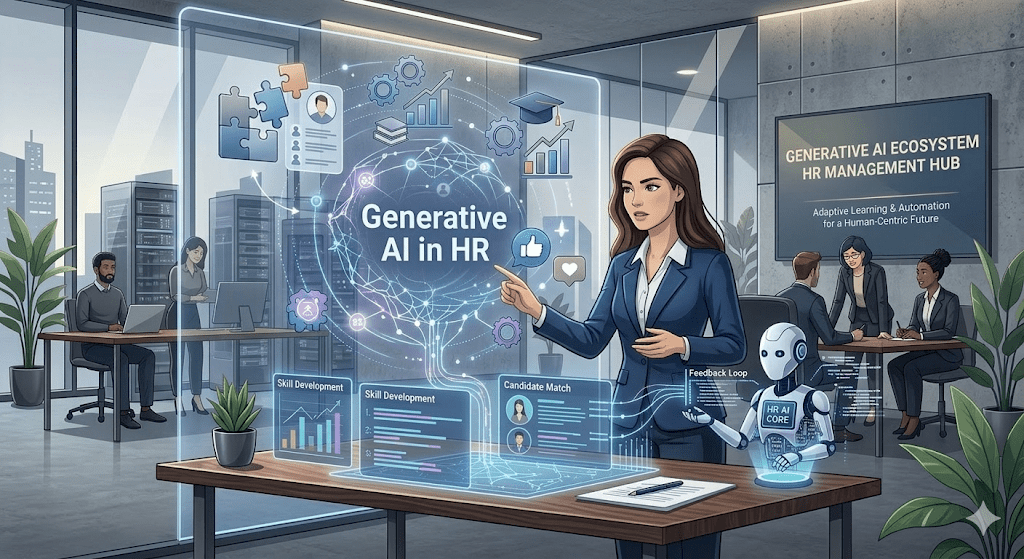
Human resource management is undergoing a major shift as organizations respond to digital transformation, evolving employee expectations, and intense competition for skilled professionals. Modern HR leaders are no longer responsible only for administrative HR tasks; they are also expected to contribute to organizational growth, workforce innovation, and employee engagement. To meet these demands, many companies are adopting AI in HR and implementing generative AI in human resources to modernize their HR strategies. By integrating artificial intelligence in HR, organizations can automate routine HR activities, generate actionable workforce insights, and strengthen talent management and workforce management across the employee lifecycle, allowing HR teams to focus more on strategic initiatives that drive long-term success.
The Expanding Role of AI in HR Transformation
The use of AI in human resources is growing rapidly as organizations realize its potential to transform HR management and improve operational efficiency. Today’s HR departments manage large volumes of employee data, HR policies, training materials, internal communications, and compliance documentation, making manual management inefficient and time-consuming. With the help of AI for HR, organizations can automate content creation, streamline document management, and extract insights from workforce data. Generative AI in HR can generate job descriptions, summarize employee feedback, prepare HR documentation, and suggest personalized training resources, helping HR teams enhance productivity while supporting better decision-making across key HR functions such as recruitment, employee engagement, and workforce planning.
Key Applications of AI in HR
Recruitment and Talent Acquisition
A major application of AI in HR is within recruitment and talent acquisition, where organizations must identify the right candidates quickly while reviewing large volumes of applications. AI-powered recruitment platforms can automatically screen resumes, evaluate candidate qualifications, and match applicants with job requirements using advanced algorithms. These tools help HR professionals streamline the hiring process, reduce recruitment time, and improve the accuracy of candidate selection. Additionally, AI for HR management can automate interview scheduling, track candidate engagement, and generate hiring insights, allowing organizations to strengthen talent management strategies and make more data-driven recruitment decisions.
Employee Onboarding and HR Documentation
Generative AI is also improving the employee onboarding experience by automating administrative steps and simplifying documentation processes. AI in human resource management can guide new employees through onboarding workflows, track completion of onboarding requirements, and answer frequently asked HR questions using AI-powered assistants. These systems can also organize HR policies, internal resources, and compliance documentation, enabling employees to easily access the information they need. By improving documentation management and onboarding efficiency, AI helps HR departments enhance employee experience while reducing the operational burden on HR teams.
Learning and Development
Artificial intelligence is transforming learning and development (L&D) within HR by enabling more personalized and data-driven training programs. Through workforce data analysis, AI for human resources can identify skill gaps, evaluate employee capabilities, and recommend customized training programs aligned with career development goals. This allows organizations to create targeted learning pathways and strengthen workforce capabilities while supporting broader workforce management and workforce planning strategies. By using AI-driven insights, HR leaders can ensure that training initiatives support both employee growth and long-term business objectives.
Performance Management
AI in HR management is also improving performance management systems by organizing performance data and generating actionable insights that help managers evaluate employee contributions more effectively. AI-powered tools can analyze productivity patterns, highlight performance trends, and identify areas where employees may benefit from additional training or support. These insights allow HR teams and managers to conduct more accurate performance reviews while maintaining fairness and transparency. By incorporating AI into performance evaluation processes, organizations can enhance employee development and promote continuous improvement across the workforce.
Employee Engagement and Experience
Another important application of AI in HR is enhancing employee engagement and workplace experience. AI-driven HR tools can review employee feedback, engagement surveys, and communication patterns to identify workplace sentiment and emerging concerns. These insights enable HR leaders and HR departments to make more informed decisions about workplace policies, employee benefits, and organizational culture. By enabling faster analysis of employee data and feedback, AI helps organizations create more supportive work environments and strengthen employee satisfaction and retention.
Workforce Planning and Workforce Management
AI is increasingly supporting workforce planning and workforce management by helping organizations forecast future staffing needs and identify potential skill shortages. Through the analysis of workforce data, hiring trends, and business objectives, AI systems can provide predictive insights that support strategic workforce decisions. This allows HR leaders to plan recruitment strategies more effectively and ensure that organizations have the necessary talent capabilities to support business expansion and long-term growth.
HR Operations and Service Automation
Generative AI is also enhancing HR operations by automating routine HR services and improving overall service delivery. AI-powered HR assistants can respond to employee inquiries, manage HR service requests, and guide employees through processes such as leave management, benefits enrollment, and policy updates. By automating repetitive HR tasks, organizations enable HR professionals to devote more time to high-value initiatives such as workforce development, strategic planning, and organizational transformation.
Advantages of Generative AI in HR
The adoption of generative AI in HR offers multiple benefits for organizations looking to modernize their human resource management practices. AI improves efficiency in HR operations by automating repetitive tasks and reducing manual workload for HR teams. It also enhances HR analytics by providing deeper insights into workforce trends, employee performance, and talent development opportunities. Additionally, AI for HR improves the overall employee experience by delivering faster responses to HR queries and enabling more personalized support. By strengthening talent management, workforce planning, and decision-making capabilities, AI empowers organizations to build more effective and future-ready HR strategies.
Challenges of Adopting Generative AI in HR
While AI in human resources offers significant advantages, organizations must address certain challenges when implementing AI-powered HR systems. Maintaining high-quality workforce data is essential, as AI algorithms depend on accurate and unbiased data to produce reliable insights. Companies must also establish responsible AI governance frameworks to ensure that AI tools are used ethically and transparently within HR decision-making processes. Furthermore, HR professionals and HR teams must receive proper training to understand how AI tools function and how to interpret AI-generated insights effectively. Addressing these challenges will help organizations maximize the benefits of AI while maintaining trust and accountability.
The Future of AI in Human Resources
The future of AI in HR management is expected to include more advanced HR analytics, predictive workforce intelligence, and automated HR processes. As AI technology continues to evolve, organizations will integrate AI with HR management systems, workforce management platforms, and enterprise software solutions to create more intelligent and responsive HR ecosystems. These innovations will enable highly personalized employee experiences, improved workforce planning, and more effective talent development initiatives. By combining human expertise with artificial intelligence in HR, organizations can build agile HR strategies that support long-term workforce transformation and business success.
Conclusion
The adoption of generative AI in HR is fundamentally transforming the way organizations manage their workforce. By implementing AI in human resources, companies can automate administrative processes, generate valuable workforce insights, and improve the effectiveness of talent management and workforce management strategies. From recruitment and onboarding to employee engagement and workforce planning, AI is enabling HR departments to operate more efficiently while delivering improved employee experiences. Organizations that strategically adopt AI for HR management will be better equipped to empower HR professionals, enhance workforce productivity, and build a resilient, future-ready workforce.
 Archie Evans Info