In the ever-evolving landscape of artificial intelligence, Decision Transformer is emerging as a groundbreaking innovation that promises to reshape the way we make decisions. With its roots in the transformative capabilities of transformers, Decision Transformer combines the power of deep learning and reinforcement learning to tackle complex decision-making problems across various domains. In this article, we’ll delve into the intricacies of Decision Transformer, exploring its origins, applications, and the potential it holds for the future.
Understanding the Transformer Architecture
Before we delve into Decision Transformer, it’s essential to grasp the fundamentals of the transformer architecture. Transformers, initially introduced by Vaswani et al. in 2017, marked a significant breakthrough in natural language processing (NLP). They employ self-attention mechanisms to process input data in parallel, making them highly efficient for tasks involving sequential data, such as language translation, text generation, and sentiment analysis.
Transformers consist of an encoder-decoder structure, with multiple layers of attention mechanisms. The encoder processes input data, while the decoder generates output sequences. These layers of attention mechanisms allow transformers to capture long-range dependencies in data, facilitating better performance in various NLP tasks.
The Birth of Decision Transformer
Decision Transformer builds upon the success of transformer architecture by adapting it to decision-making scenarios. It was introduced by researchers at Google Research in 2021 as a novel approach to reinforcement learning. Reinforcement learning is a machine learning paradigm where an agent learns to make decisions by interacting with an environment and receiving rewards or penalties based on its actions.
Traditional reinforcement learning algorithms often struggle with scalability and sample efficiency when dealing with complex environments. Decision Transformer aims to address these challenges by bringing the power of transformers into the realm of reinforcement learning.
How Decision Transformer Works
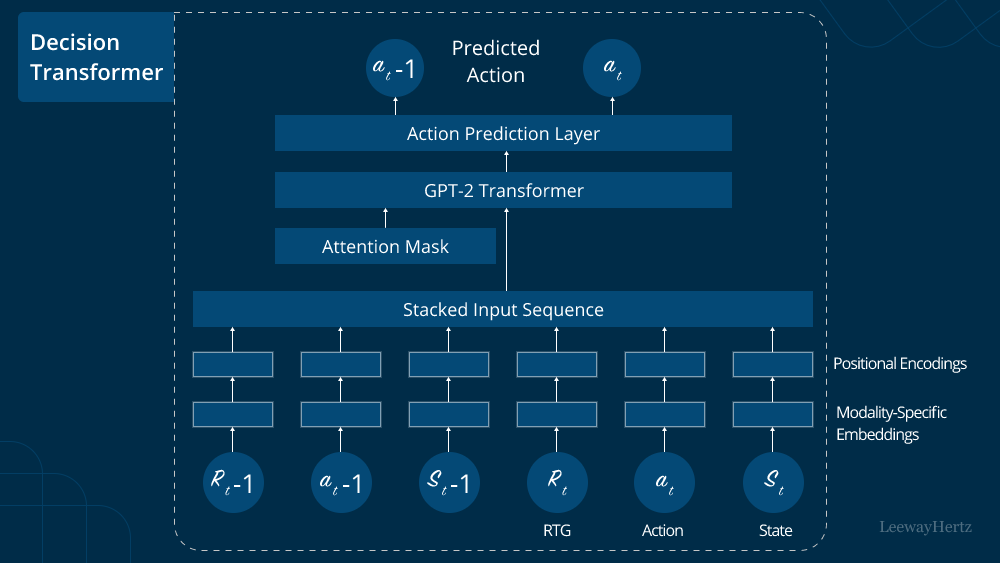
Decision Transformer works by transforming the raw sensory data from an environment into a structured representation that is suitable for decision-making. It accomplishes this through a two-step process: perception and decision.
Perception
In the perception phase, Decision Transformer takes in raw sensory input, such as images or sensor readings, and processes it through a series of transformer layers. These layers extract relevant features and encode them into a compact representation. This step allows Decision Transformer to capture important information from the environment efficiently.
Decision
Once the perception phase is complete, Decision Transformer uses the encoded representation to make decisions. It employs reinforcement learning techniques to select actions that maximize a predefined reward function. This process involves evaluating the potential outcomes of different actions and selecting the one that leads to the most favorable outcome.
The key innovation of Decision Transformer lies in its ability to handle long-term dependencies and complex decision-making scenarios effectively. By leveraging the self-attention mechanisms of transformers, it can consider past observations and future consequences when making decisions, leading to more informed and intelligent choices.
Applications of Decision Transformer
Decision Transformer has shown great promise in various applications across different domains:
Autonomous Vehicles
In the field of autonomous driving, Decision Transformer can process sensor data from cameras, lidar, and radar to make real-time decisions, such as lane changes, braking, and avoiding obstacles. Its ability to handle complex and dynamic traffic scenarios makes it a valuable tool for enhancing the safety and efficiency of autonomous vehicles.
Healthcare
In healthcare, Decision Transformer can assist in medical diagnosis and treatment planning. By analyzing patient data, including medical images, lab results, and historical records, it can provide recommendations to healthcare professionals, helping them make more accurate and timely decisions.
Finance
In the financial industry, Decision Transformer can be applied to algorithmic trading and portfolio management. It can analyze market data and historical trading patterns to make trading decisions that maximize returns while minimizing risks.
Robotics
In robotics, Decision Transformer enables robots to perform tasks in unstructured environments. It can process sensory information to navigate through cluttered spaces, manipulate objects, and adapt to changing conditions, making it a valuable tool for industrial automation and service robots.
Challenges and Future Directions
While Decision Transformer holds immense potential, it also faces several challenges:
Data Efficiency
Training Decision Transformer models often requires large amounts of data, which may not always be available, especially in domains where collecting data is expensive or time-consuming. Researchers are actively working on improving data efficiency to make Decision Transformer more accessible.
Computational Resources
The computational demands of training and deploying Decision Transformer models can be substantial. Advancements in hardware and software optimizations are needed to make it more practical for real-world applications.
Interpretability
Interpreting the decisions made by a Decision Transformer model can be challenging, particularly in high-stakes applications like healthcare and finance. Researchers are working on methods to enhance the interpretability of these models to ensure transparency and accountability.
Conclusion
Decision Transformer represents a significant leap forward in the field of artificial intelligence and decision-making. By combining the strengths of transformers and reinforcement learning, it has the potential to revolutionize a wide range of industries, from autonomous vehicles to healthcare and finance. As researchers continue to refine and expand its capabilities, we can expect Decision Transformer to play an increasingly pivotal role in shaping our AI-driven future. Its ability to make intelligent, data-driven decisions opens up new possibilities and opportunities for innovation, making it a technology to watch closely in the years to come.

